Whitney House (1956)
Completed ca. 1917, Whitney House has survived the transformation of the neighborhood from residential homes to a modern college campus.
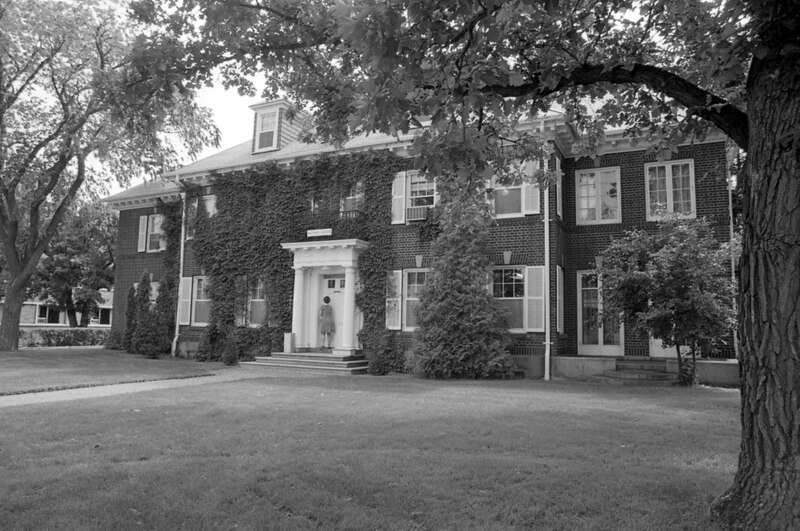
Whitney House, June 1971
Acquisition
In the fall of 1955, St. Cloud State acquired the home. The campus was still along 1st Avenue South while its physical growth westward was a few years away. With the death of Alice Wheelock Whitney, wife of Albert Whitney, on December 5, 1954, the home was willed to her grandchildren. The Chronicle’s November 2, 1955, issue reported the former Whitney home located at 524 1st Avenue South was to be purchased by St. Cloud State using donated funds by Albert and Alice’s three children: Wheelock (Sr.), Pauline, and Lois, as well as $30,000 appropriated by the 1955 state legislature. St. Cloud State took possession of the home on July 1, 1956.
Whitney Family History
The Whitney family were some of the earliest settlers in Stearns County, Minnesota, and produced several generations of Minnesota businessmen, philanthropists, civic leaders, lawyers, and Republican politicians. Ephriam and Elizabeth Whitney grew up in Maine before moving to Minnesota shortly after their 1854 marriage. They farmed various parts of Stearns County.
From Moscow, New York, Alice Wheelock arrived in St. Cloud in 1885 to attend the Normal School at St. Cloud. She lived with her sister Mary, who taught at the Normal School. A younger sister, (Martha) Lucille, entered St. Cloud State in November 1895 but did not graduate.
Ephriam and Elizabeth Whitney’s son, Albert G. Whitney, married Alice Wheelock in 1891. Albert engaged in local real estate and loan insurance business as well as building a railway which linked downtown areas of Waite Park, St. Cloud, and Sauk Rapids. He was also involved with the creation of public utilities in St. Cloud and throughout Stearns County. Albert passed away on January 11, 1922. Alice was a well-known and prominent St. Cloud citizen, active in community social programs, civic projects, and a leading socialite.
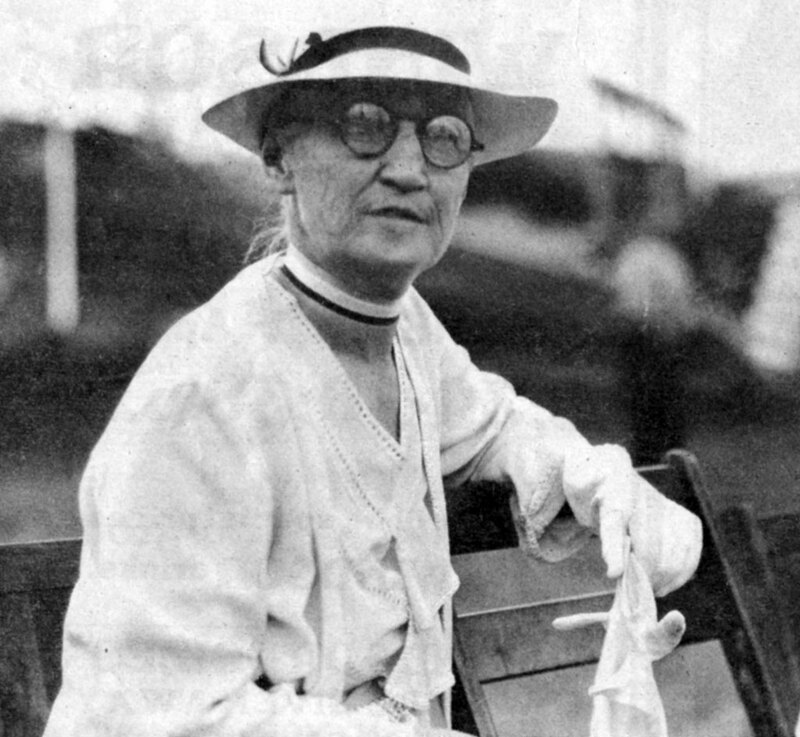
Alice Wheelock Whitney, 1935
Construction
Whitney House stood on the site of the former 1891 Whitney home. The home was moved to 3rd Avenue South and a new home was built in its place. Using architectural plans completed by Tyrie and Chapman with C.A. Gage in September 1916, the west facing home was under construction and “nearing completion” by early January 1917. At the June 14, 1917, meeting of the Minnesota State Normal School board, Albert made a request to purchase “certain” grounds in the rear of his residence east to the Mississippi River, now part of the normal school grounds. A committee of three was appointed to study the issue. At the August 14, 1917, meeting, the committee reported its findings to the normal school board. A law (Chapter 55) recently passed by the 1917 state legislature allowed specific property near the home to be sold on the authority of the governor. The committee reported after their August 2 visit to campus that the property should not be sold as they felt the property was useful and essential to the school. The minutes reported the “grounds furnish a beautiful and retired park for the use of the students of the school, especially those domiciled in Lawrence Hall, both for purpose of recreation and study.”
The home hosted at least three famous visitors. In January 1940, African American singer Roland Hayes had dinner at Whitney House. In October 1941, First Lady Eleanor Roosevelt visited the home. In April 1942, African American vocalist Marian Anderson was a guest of Alice Whitney.
Campus Use
Once St. Cloud State took possession of the home in July 1956, a committee was formed to decide how to use it. The September 25, 1956, Chronicle reported the George Budd-led committee recommended the home be used as a dormitory. Uses rejected were for a student union and for Health Services. The state college board, at their July 24, 1956, meeting, approved the use of Whitney House as a dormitory and to spend up to $12,000 for equipment, repair, and minor remodeling.
From 1956 to 1965, Whitney House, which was never officially named, served as a dormitory for 30 women. In the spring of 1964, President Budd planned redecorate the building to house the St. Cloud State’s president. The May 30, 1964, Chronicle issue reported the state college board approved the action and had support from the Whitney family. Budd came under fire for using $1,500 of dormitory funds to redecorate the home as a residence. The president argued the money was going to be spent regardless, since nothing, he claimed, had been done to the home since its acquisition in 1955. The matter was dropped.
During the 1965/66 academic year, Whitney House was used as a sorority house for Alpha Phi. In 1966, administrative offices moved out of Stewart Hall into Whitney House, including the president’s office, Campus Planning, and Information Services. The 1969 state legislature appropriated $500,000 to “convert Kiehle Library and Whitney House to administration and central service facilities.” Administrators soon realized that Kiehle and Whitney House were too far from the west edge of campus, which stood at 3rd Avenue South, to be the front door of St. Cloud State. With the completion of Administrative Services in the summer of 1975, campus units moved out of Whitney House, including the president’s office. Other offices moved into Whitney House: Central Minnesota Public Service Consortium, Continuing Education, External Studies, International Studies, Traffic Safety, and the College of Liberal Arts and Sciences.
A garage/carriage house that sat just behind the home was demolished in 1974.
Other units to occupy Whitney House later were the College of Social Sciences, the School of Public Affairs, and, lastly, the Department of Psychology. In January 2020, Psychology moved to Stewart Hall in space formerly occupied by Counseling. As of 2026, Whitney House is empty.
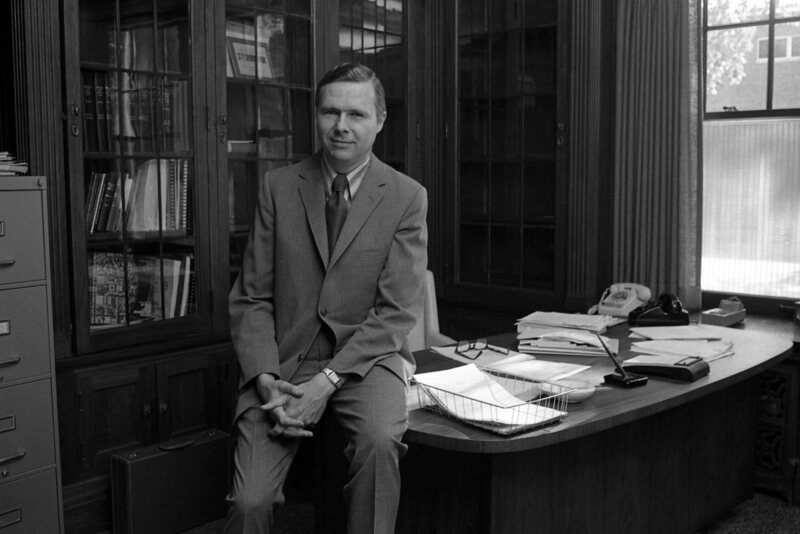
President Charles Graham in his Whitney House office, July 1971
Architecture
Whitney House is a handsome example of Georgian Revival using more elaborate elements of the style than either Lawrence Hall or Riverview. The house is built of hollow tile blocks veneered with Oriental autumn-leaf brick. The house has a distinctive eastern U.S. feel to it like 18th century plantation houses found in Tidewater Virginia. The Whitney family was likely influenced by homes they saw on their travels.
The 1916 blueprints for Whitney House are available in the University Archives’ Search portal.
Whitney House, 1918?
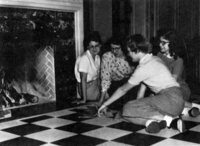
Resident sit by fireplace, 1058
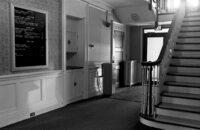
First floor main foyer, 1987
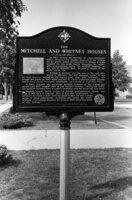
Mitchell and Whitney Houses historic marker, September 1978
Additional sources:
- St. Cloud Daily Times, July 16, 1916
- St. Cloud Journal-Press, January 2, 1917
- St. Cloud Daily Times, November 2, 1955
- St. Cloud Daily Times, May 27, 1964
- St. Cloud Daily Times, June 15, 1964
- St. Cloud DailyTimes, June 27, 1964
- Ames, Alexander (2012). Mansions of Memories. Preservation, Destruction and the Construction of Place in Central Minnesota. Thesis