Selke Field (1931)
Due to the campus being mostly landlocked on the western shores of the Mississippi River, campus moved much of its athletic activities to the city of St. Cloud’s East Side in the 1930s.
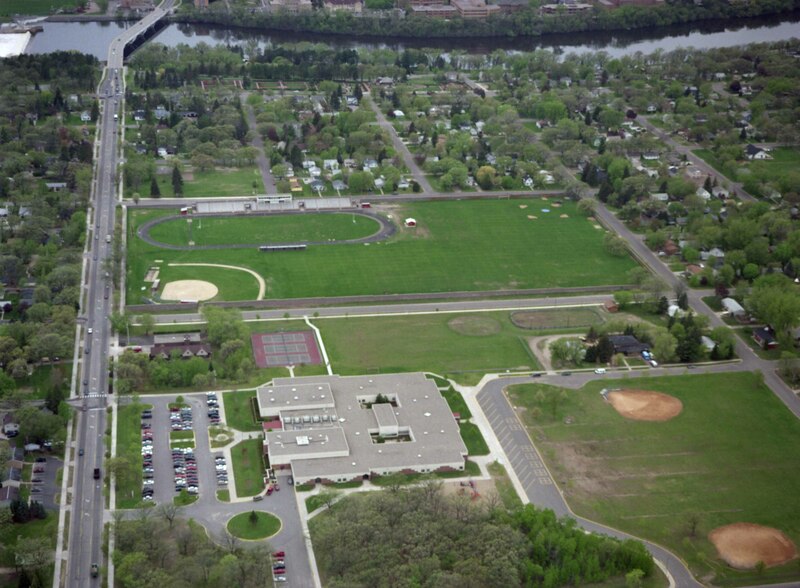
Selke Field, June 2001
Acquisition and Use
In the May 2, 1931 edition of the St. Cloud Times, it was announced St. Cloud State resident director Alvah Eastman and his wife had donated property in east St. Cloud for a recreational field. Other additional property was purchased with student funds for college activities, and the city gave control to St. Cloud State for two additional blocks. The city also agreed to “vacate all streets and alleys in the plot, assuring one large recreation grounds,” totaling around 15 acres.
Improvements began immediately. Possibilities included a football field, baseball diamond, golf course, running track, and tennis and volleyball courts. A June 25, 1931 St. Cloud Times article announced an informal dedication with President George Selke and Physical Education head Al Brainard hitting golf balls on the first tee of the new golf course. It was dubbed “College Recreational Field”.
Due to the new college six-hole golf course, a college golf team was organized in 1932.
Until 1937, it appears the only activity was a small golf course. The Chronicle’s May 4, 1934, issue reported three holes were added “to make the course a regulation nine-hole course.”
The September 28, 1934 issue of the Chronicle reported that a tract of land was acquired adjoining the golf course “which will soon undergo further development.”
Continued Improvements and Use
In 1936-1937, the Works Progress Administration (WPA) built a 3,150 foot and 8 to 10 foot tall locally quarried granite wall to surround the field. Costing between $40,000-$50,000, the wall is the most distinguished feature of Selke Field. Inside the wall, a football field was built surrounded by a cinder track (with a 220 yard straightaway), and a baseball field was clayed, seeded, and rolled, and a portable backstop was erected. The football field was equipped with a Buckner pop up athletic sprinkling system supplied with water from the field’s own 101 foot well.
The field was dedicated at homecoming on October 23, 1937, and dubbed “Sports Field”. St. Cloud State defeated the Winona State football team, 18-0, with a homecoming theme of “Wall-up Winona.”
In the fall of 1939, construction started permanent stands to seat 3,000, nearly double of the current capacity. According to an October 6, 1939 Chronicle article, 14 rows of 400 foot long bleachers were to be built and the west wall was to be raised 5-6 feet. In addition, underneath the stands, store rooms and lavatories were to be built, along with room for showers in the future. New ticket office and press box were built. Two more openings were also cut into the existing walls. Done by the Works Progress Administration, the work was scheduled to be complete in the fall of 1940. According to a January 1, 1940, St. Cloud Times article, the “state legislative emergency committee approved $10,000 in funding “to improve the seating facilities at the new sports field”.
Construction continued in the fall of 1940 and by October, the grandstand was two-thirds complete. The grandstand appeared finished by the spring of 1941 when the baseball team played home games there and spring commencement was held as well.
In April 1963, space underneath the grandstand was remodeled while included two shower rooms, two locker rooms, two rooms for visiting coaches, a first aid room, and a storage room.
In the spring of 2003, around 100 feet of the southeast portion of the wall was removed as it was leaning. Costing around $10,000, Donlar Construction Company capped the ends of the still remaining walls and added a “cyclone fence” built in its place with climbing vines planted and a new gate replacing the former granite entrance.
The 20-year-old press box was replaced in the fall of 1982.
Land Swap
In 1976, St. Cloud State completed a land swap with the city of St. Cloud. Property called “Union Park” was city owned and within the Selke Field walls. It was traded for property just west of Selke Field that once was the location for the long-demolished Brainard Hall dormitory.
Veterans Housing Complex
In 1946-1947, 24 surplus military huts were purchased and installed inside Selke Field’s wall on the north end. These huts initially housed military veterans and, later, married St. Cloud State students. The housing complex, informally called Veterans Housing, was closed in the summer of 1968.
Naming
On May 13, 1946, the Minnesota state college board renamed Sports Field as “Selke Field” to honor President George Selke’s service to St. Cloud State.
Gradual Closure and Property Sold
The football field closed after the 2003 season and relocated to the new Husky Stadium built just east of Halenbeck Hall.
Previously playing at the VA in St. Cloud, softball moved here for the spring 1980 season. They opened the new softball diamond by sweeping a doubleheader with Winona State 4-2 and 5-4. For the spring 2024 season, softball permanently moved to the dome at Husky Stadium.
In April 2024, the university attempted to rezone the property from R-2 to R-5, which would have allowed for a 350 plus apartment building. Rezoning failed. In March 2025, St. Cloud State put Selke Field up for sale and in August 2025, St. Cloud State announced the sale of the property to the Central Minnesota Youth Soccer Association (CMYSA) for $350,000. CMYSA took possession shortly afterwards.
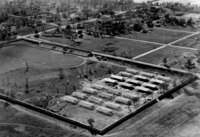
Brainard Hall, Selke Field, and Veterans Housing Complex, 1946
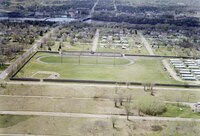
Selke Field and the Veterans Housing Complex, 1965?
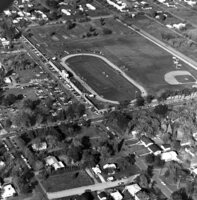
Football game at Selke Field, October 1972
Additional sources:
St. Cloud Times, September 27, 1940, October 16, 1940, September 16, 1941
Press release, April 19, 1963
Steve Ludwig email April 1, 2004; Chronicle, April 14, 2003
Chronicle, July 21, 1982
St. Cloud Times, April 21, 1980