Brainard Hall (1947)
As St. Cloud State slowly grew before World War II, there was a need for a campus dormitory for men. Though women had on-campus living options, men did not. Men were encouraged to live at home or in nearby boarding houses while attending St. Cloud State.
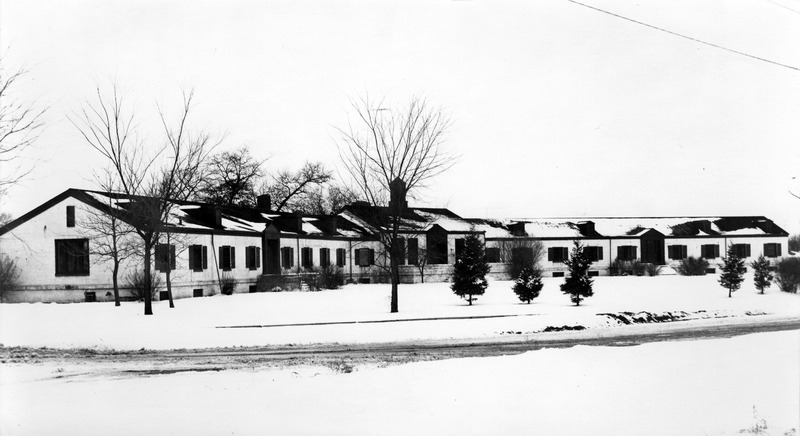
Brainard Hall, 1947-1949
Need and Construction
By 1939, St. Cloud State decided to build a men’s dormitory. In March 1939, architectural plans were completed by Twin Cities architects Polivka and McMahon. The plans were prepared for the National Youth Administration (NYA), a federal Works Progress Administration program to provide work and education for young adults, to construct the new dormitory.
On November 10, 1939, the Chronicle reported former St. Cloud State resident director Alvah Eastman donated 11 lots of property, just west of the south end of Sports Field (today’s Selke Field) between 9th and 10th Avenue Southeast. Construction began on October 15. The one-story building was to be “Y” shaped, include a basement, and face east. The first floor was to include a kitchen, dining room, lounge in the main (middle) section. The north and south wings would contain 32 double rooms each. In addition, there was to be space for general offices, a director’s office, and check rooms. Much of the basement was slated to be used by St. Cloud State athletic teams who played at nearby Sports Field. The space was to contain storage, showers, and dressing rooms. The rest of the basement would be home to recreational rooms and space held for future use.
The building was scheduled to be finished for the fall 1940 academic term but was not. While construction had started, it remained unfinished throughout 1940. In December 1940, St. Cloud State president George Selke was criticized for the building’s construction. According to a St. Cloud Daily Times December 13, 1940 article, Selke was accused by Minnesota state commissioner of administration Leslie Gravlin that construction began without authorization. Selke responded the campus needed a men’s dormitory and knew the NYA built other college dormitories. Selke said his ultimate goal was to present a completed dormitory without state funds. The building was on donated property with $6,500 was gifted to St. Cloud State, including a $2,000 donation from Selke himself, to begin construction.
Construction Continues and Uses during World War II
The June 27, 1941, issue of the Chronicle reported the federal government, through the NYA program, approved $19,000 to complete the building. The reason given was "not enough money was originally set aside to finish the building." Work had been suspended but construction was to be restarted soon. The foundation was already finished along with several walls.
According to St. Cloud Daily Times newspaper articles, construction was scheduled to be completed by late summer 1942 and was was ready for use by fall 1942. Due to the decline in student enrollment, especially men due to World War II, the building was used for other purposes. The Victory Corp program soon occupied the building where men and mostly women aged from 16-25, including high school students, took shop courses to train for work in war industries.
By sometime in 1943, the NYA program ended and the building was no longer used for war defense training. An October 30, 1943 article from the St. Cloud Daily Times reported the building was used to store equipment from Lawrence Hall as Army Air Force cadets had moved into that dormitory. President Dudley Brainard said that the plan for the building after the war was to use it as a men’s dormitory.
The building continued to be used as storage, including for idle machinery previously used for war defense training. In June 1945, the building was leased to house soldiers who were assigned to assist at the local veterans’ hospital. It is unclear how long the lease was and when the building was vacated.
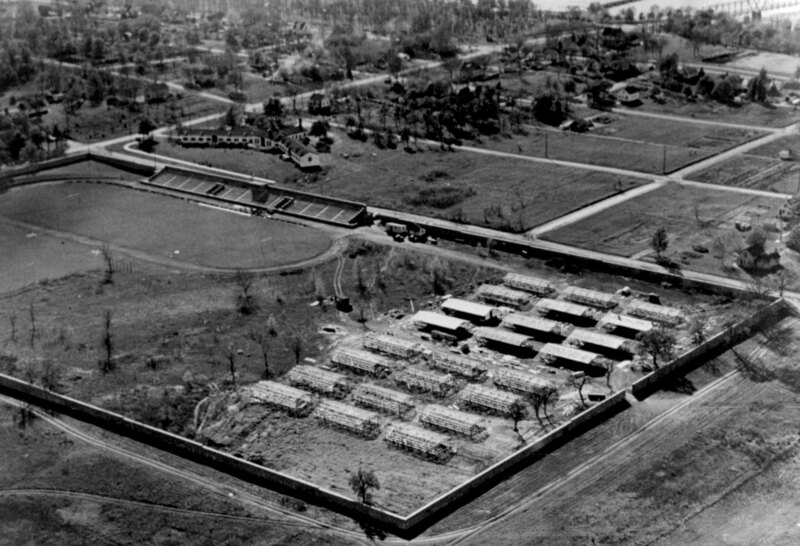
Brainard Hall (upper left corner), Selke Field, and Veterans Housing Complex, 1946
Conversion to a Dormitory
At their March 5, 1946 meeting, the Minnesota state college board authorized St. Cloud State to convert the building into a dormitory for men. Work progressed but the Chronicle reported on October 4, 1946 that the renovation was delayed due to the lack of construction material. On November 2, 1946, the Chronicle reported that the building would soon open to house 110 men living in Eastman Hall’s main gymnasium. While the men moved in, renovation continued and completed in January 1947. A party was held at the new dormitory on March 15, 1947, and “may also be considered an open house for the dorm as this will be the first party held there.”
Naming and Dedication
By fall 1947, the building was in full operation and with a new name – Brainard Hall. The Minnesota state college board approved the name “Brainard Hall” to honor the services of Dudley S. Brainard, long-time St. Cloud State faculty member and its acting president from 1943 to 1947. The building was dedicated on October 11, 1947, during homecoming. New St. Cloud State president John Headley was the main speaker.
Closure and Demolition
Time and campus changes were not kind to Brainard Hall. The July 11, 1958 St. Cloud Daily Times reported St. Cloud State president George Budd was considering the building’s closure. It needed a new boiler and roof which architects advised were not feasible. In addition, Brainard Hall was no longer needed. In fall 1958, Mitchell Hall opened as a women’s dormitory with an addition due to open in fall 1959. Once Mitchell Hall opened, Shoemaker Hall, another women’s dormitory, was set to house male students. Brainard Hall closed before the fall 1958 quarter. The state college board at their December 19, 1958, meeting supported the decision to close Brainard Hall, adding it “be abandoned for dormitory purposes and to investigate the possibility of demolishing the building.” In December 1960, Landwehr Heavy Moving razed Brainard Hall. The property was then used as parking for Selke Field events.
Land Swap and Use
In a 1976 land swap with St. Cloud State, the city of St. Cloud acquired the property except for one lot that was privately held. That lot was purchased by the city in 1983. The property became a park and named West Selke Park. In 1986, Rotary Club donated funds to equip the park and the name was changed to “Rotary Park East” and, in 2025, is still intact. The Rotary Club donated funds for a basketball court, picnic tables and grills, and new playground equipment.
The blueprints for the demolished Brainard Hall are available.
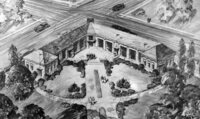
Architect rendering, 1935-1939
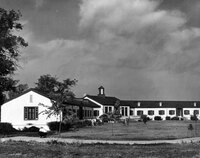
Brainard Hall, 1946-1958
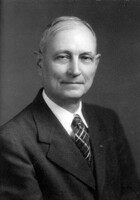
Dudley Brainard, 1943-1947
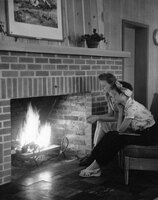
Two women enjoy Brainard Hall fireplace, 1943?
Additional sources:
- St. Cloud Daily Times, November 4, 1939
- St. Cloud Daily Times, December 13, 1940
- St. Cloud Daily Times, February 7, 1941
- College Chronicle, June 27, 1941
- St. Cloud Daily Times, January 19, 1942
- St. Cloud Daily Times, July 25, 1942
- St. Cloud Daily Times, November 20, 1942
- St. Cloud Daily Times, January 28, 1943
- St. Cloud Daily Times, February 22, 1944
- St. Cloud Daily Times, May 9, 1945
- St. Cloud Times, May, 8, 1986